How To Dress For London In December?
A practical layering guide for London in December: typical temperatures, rain, early sunset, what to wear on open-top bus tours and at Christmas markets, and the footwear that survives a full day.
How To Dress For London In December?
Dress for London in December with three to four thin layers under a waterproof outer layer, warm shoes you can walk five miles in, a hat, gloves and a compact umbrella. Typical days run 8 to 10 C with lows of 3 to 5 C, and the real challenge is moving between chill streets, crowded markets and overheated interiors all day.
That last point is the one most visitors get wrong. London in December is not Lapland. The cold is a damp, penetrating sort that sits around freezing but rarely far below, and the bigger problem is that a day of Christmas sightseeing involves constant transitions: a walk down a wind-tunnel street, then a packed market stall area, then a warm shop, then an hour standing still watching a light trail. A single thick coat handles none of that well. Layers you can remove and carry handle all of it.
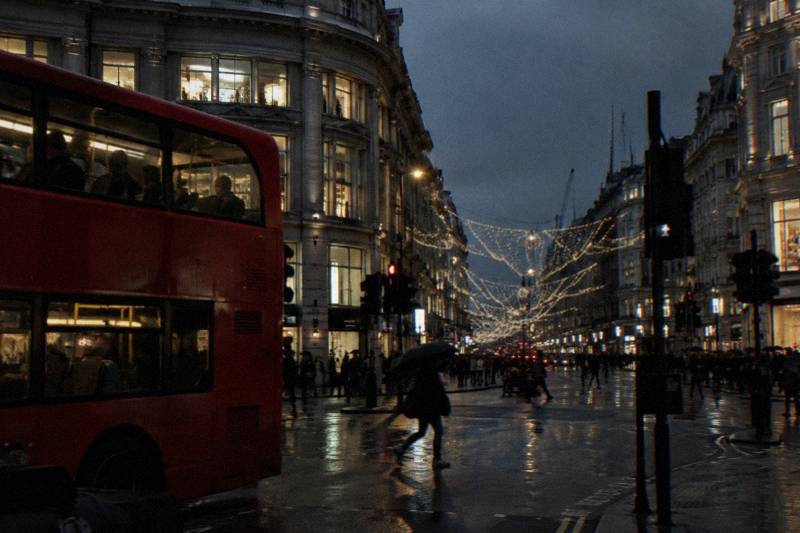
The other December reality is darkness. With sunset around 15:50 to 16:00 in mid December, most Christmas lights viewing happens after dark, which is exactly when temperatures drop. Whatever you wear for the afternoon is what you will be wearing at 6pm on an open deck or in a market queue, so plan the outer layer for the evening, not the midday. If the early darkness has you second-guessing the trip itself, our honest look at whether a London Christmas trip pays off weighs the cold, the crowds and the lights against the cost.
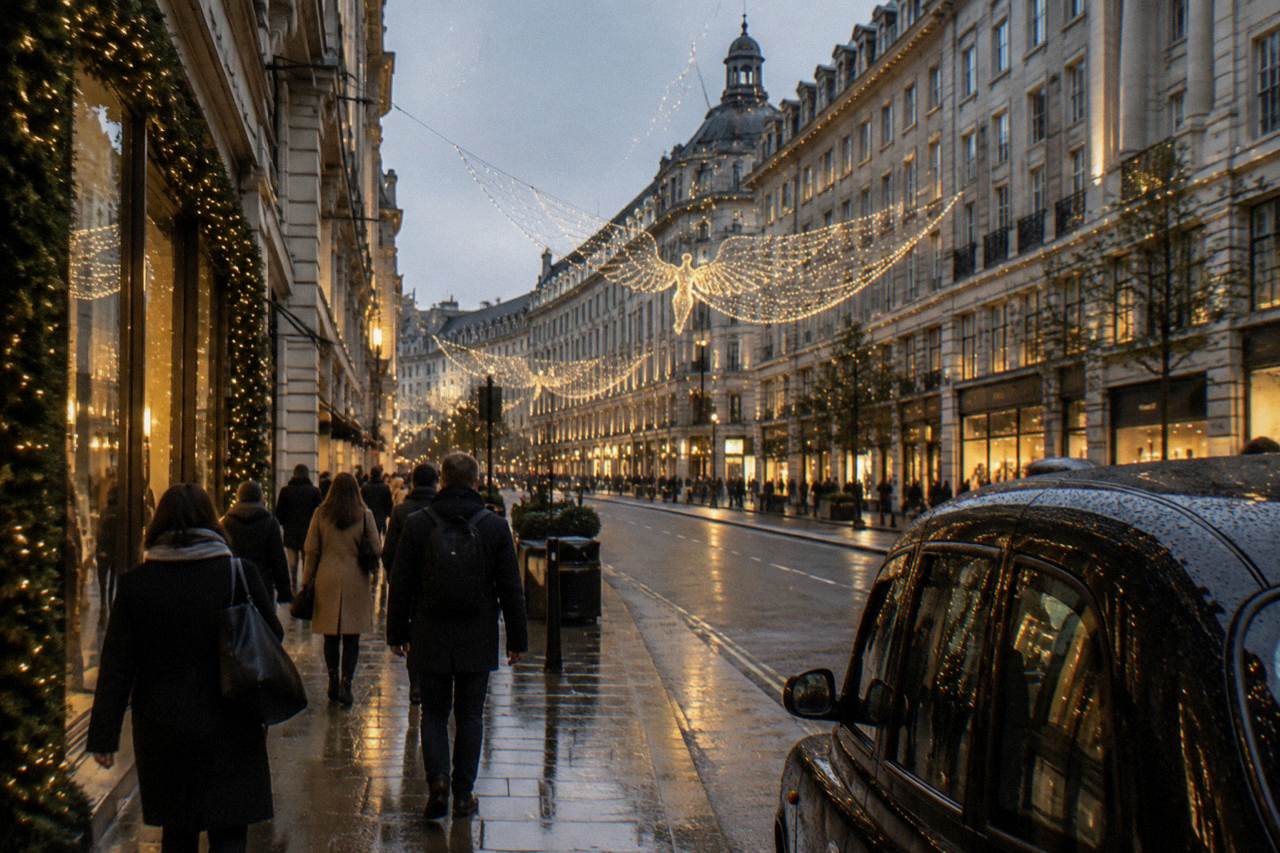
The Christmas lights season also shapes what "dressed right" means. Regent Street's lights return on Thursday 5 November 2026, Carnaby Street switches on Wednesday 4 November 2026 and Covent Garden follows on Thursday 12 November 2026, so from early November onward the evening light-viewing wardrobe is in play for two full months. If you are booked on the "Open-Top Bus, Live Guide" lights tour, from $40 per person with a 4.1 rating from 531 reviews, the top deck at night is the coldest place you will stand all trip. The "Lights and Bites Routemaster Bus" and the year-round "Afternoon Tea Cruise, 1.5 Hours" sit at the other extreme: warm, sheltered, and the place where removable layers earn their keep.
What Is The Typical London December Weather?
Expect daytime highs of about 8 to 10 C and overnight lows of 3 to 5 C, with roughly 50 to 60 mm of rain spread across the month rather than falling in dramatic storms. Sunset lands near 15:50 to 16:00 in mid December, so full darkness arrives before many attractions even open their evening sessions. Snow is possible but uncommon; rain and wind are near certainties over a multi-day stay.
These are long-term averages, not a forecast, and they hold steady across the month. Early December and late December feel much the same in London because the city's maritime climate flattens the extremes. What varies day to day is wind and rain: a dry, still day at 9 C feels mild, while a wet, windy day at the same temperature feels raw within an hour of standing outside.
The pattern that matters for planning is the swing between outdoor and indoor temperatures. Shops, hotels, buses and museum galleries in London are heated to a level that makes a full winter outfit uncomfortable within about ten minutes. That is the argument for a base layer you would be happy in indoors plus a serious outer shell, rather than one insulated parka worn start to finish.
For evening events, the timing compounds the cold. Christmas at Kew closes at 10pm with last entry between 7 and 8pm depending on the gate, and the trail is roughly 3km of outdoor walking, so you are outside for two to three hours in the coldest part of the day. Winter Wonderland is similar: open until 10pm most evenings with last entry around 9:30pm. Neither is a place for fashion footwear and a wool coat with no rain protection.
The practical translation: your December London wardrobe is built for a city that is cool, damp and dark by 4pm, and where the marquee Christmas activities are evening-long outdoor affairs. Dress for the evening and you have dressed for the day.
How Should You Layer For A Day Of Lights And Markets?
Use a four-part system: a breathable base layer, one warm mid layer such as a fleece or light wool sweater, an insulating layer you can shed such as a packable down jacket, and a waterproof outer shell. Add a scarf, hat and gloves that fit in pockets when the sun is out. This lets you strip to a single layer inside heated spaces and rebuild to full warmth for an evening market without ever carrying a heavy coat.
The base layer is the piece people skip and then regret. A synthetic or merino base under a shirt keeps sweat from chilling you when you move between warm and cold, which happens a dozen times a day in London. Cotton next to the skin is the mistake: it holds moisture, and damp cotton at 5 C is miserable on an open deck.
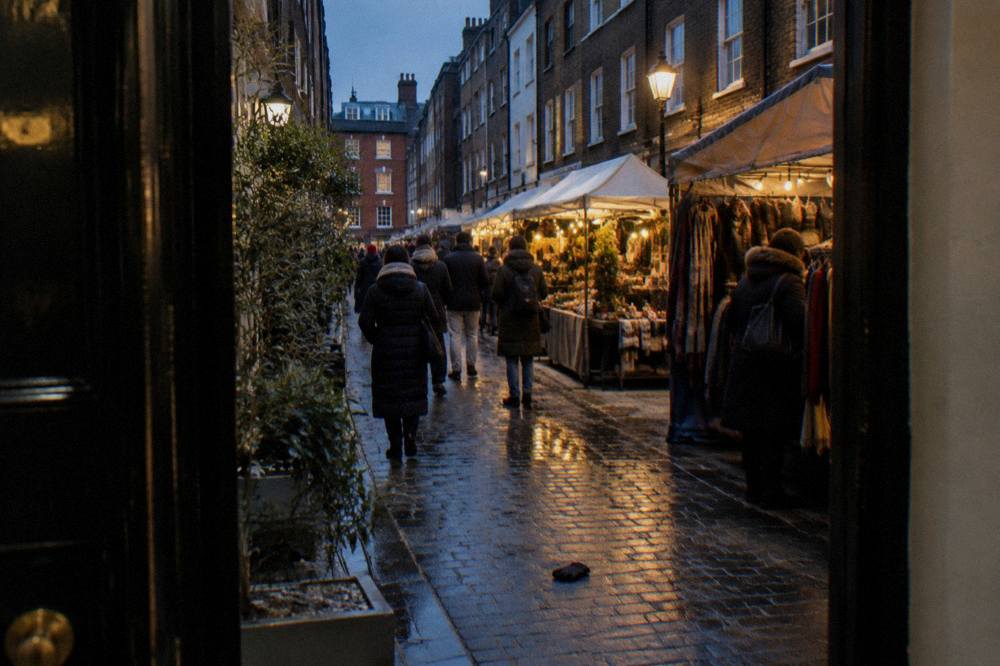
The mid layer is your indoor outfit. A fleece, wool sweater or knit over the base is what you will actually be wearing in shops, on the Underground and at any seated event. The "Markets Walk, Mulled Wine Included" walking tour, rated 5 from 72 reviews and from $61 per person, spends 1 hour 30 minutes moving between outdoor markets and warm stops, and it is exactly the sort of itinerary where a zip-out mid layer beats a fixed heavy coat.
The shell is the piece that does the rain work. London's December rain is usually light and persistent rather than torrential, so a hooded waterproof jacket handles almost everything, and a compact umbrella covers the rest. Waterproof trousers are overkill for city sightseeing; waterproof shoes are not.
| Layer | What it is | When it is on | When it is in your bag |
|---|---|---|---|
| Base | Merino or synthetic long-sleeve top | All day, indoors and out | Never |
| Mid | Fleece, wool sweater or knit | Indoors, on transport, mild afternoons | Warm interiors, midday |
| Insulator | Packable down or synthetic puffer | Evening outdoors, open decks, queues | Indoors, heated venues |
| Shell | Hooded waterproof jacket | Rain, wind, all evening outdoor time | Dry mild afternoons |
| Extras | Scarf, hat, gloves | After dark and on decks | Midday indoors |
One refinement: make the insulator thin enough to stuff in a daypack. The difference between a good December layering system and a bad one is whether the shed layers are carryable. A bulky coat left in a hotel room because it is too heavy to haul is a coat you will miss at 7pm in Kew.
What Should You Wear On An Open-Top Bus Tour?
Wear your warmest complete layering set, a windproof and waterproof outer layer, a warm hat and gloves, and treat the top deck like a two-hour exposure to moving cold air. The lower deck is heated and forgiving, so the deck you choose is a clothing decision as much as a viewing one. On any open-top ride, wind chill at speed makes 8 C feel close to freezing on exposed skin.
The open-top lights tours are the single most clothing-sensitive products on the roster. The "Open-Top Bus, Live Guide" tour, 1.5 hours from $40 per person with free cancellation, offers both decks, and the difference between them is roughly the difference between a mild evening and a cold one. Up top you get the unobstructed view of the Regent Street angels and the Covent Garden displays; below you get warmth. Dress properly and you can have both by moving between decks at stops.
The same logic applies across the bus family. The "Live Guide, 1.5-Hour Ride" at from $33 per person, rated 4 from 5,439 reviews, and the "Open-Top Night Ride, Live Guide" at from $40 with a 4.5 rating from 2,049 reviews, both run after dark when temperatures are at their floor. The "Vintage Double-Decker Lights Ride", from $43 per person, adds a heritage bus with period character and, on some departures, a longer run of up to 2 hours 10 minutes, which is a long time to sit in moving cold air in the wrong gloves.
The kit list for a top deck is short and non-negotiable: a windproof outer layer, a warm hat that covers the ears, gloves, a scarf that can cover the neck and lower face, and trousers rather than anything that lets wind up a hem. The "Lights Bus, Optional Afternoon Tea" tour, from $34 per person with a 4.4 rating from 38 reviews, solves the problem differently by adding a heated indoor component, which is a sensible hedge for anyone who runs cold.
If you want the lights without the exposure at all, the walking alternatives trade wind chill for foot mileage. The "Silent-Disco Walk With Music", rated 4.9 from 118 reviews and from $52 per person, keeps you moving for 1 hour 45 minutes, and moving bodies stay warmer than seated ones. Movement is warmth, and standing on a deck is the one Christmas activity where you generate almost none.
Which Shoes Survive A Full Day Of Christmas Markets?
Waterproof walking shoes or boots with real tread and a cushioned sole are the only correct answer for December London. Expect cobblestones, market mulch, wet pavement, tube station stairs and five-plus miles of walking in a day. Fashion trainers, smooth-soled leather shoes and anything that soaks through will end your evening early. Ankle support and grip matter more than insulation, because damp feet are cold feet.
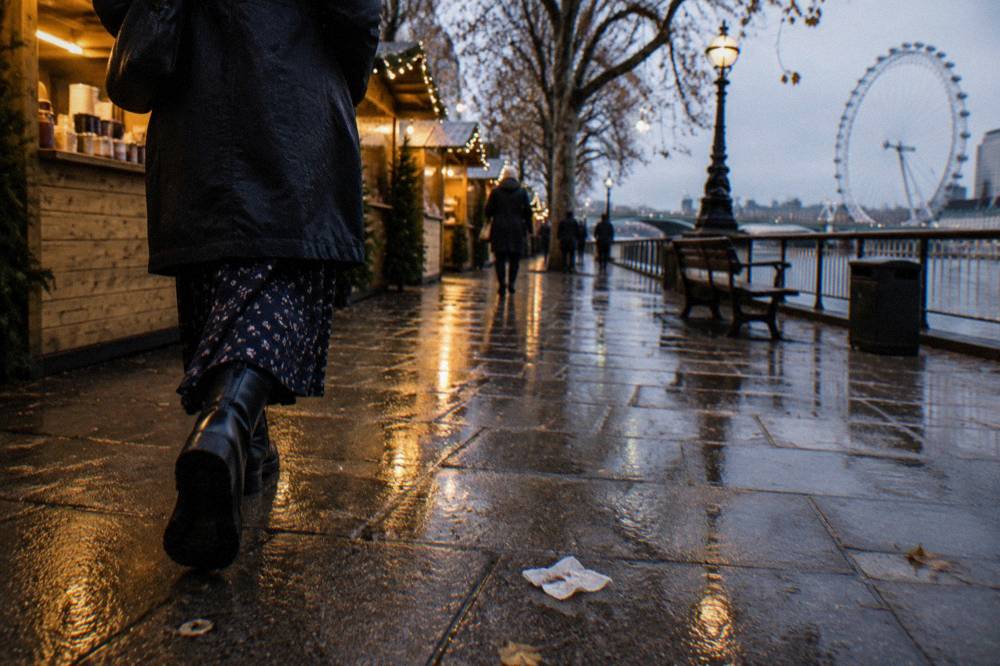
The footwear question is bigger in December than in any other month because the Christmas itinerary is a walking itinerary. The markets themselves are the hard case: Hyde Park Winter Wonderland is grass and gravel that turns to mud in the rain, Southbank Centre Winter Market runs along a riverside walkway that is exposed and wet, and the light trails add unpaved ground after dark. None of it is extreme, but all of it punishes the wrong shoe for hours at a time.
Insulation is the smaller half of the equation. A waterproof membrane keeps rain and puddle splash out, and dry feet at 5 C are comfortable feet. Grip is the other half: December rain on London's paving and market surfaces is slick, and a fall on wet cobbles is the fastest way to lose a day of the trip.
| Itinerary | Ground you will cover | Shoe that works | Shoe that fails |
|---|---|---|---|
| Winter Wonderland | Grass, gravel, mud, queues | Waterproof boots with tread | Canvas trainers |
| Southbank Winter Market | Riverside paving, wet and windy | Waterproof walking shoes | Smooth leather soles |
| Christmas at Kew | Roughly 3km of trail, some unpaved, after dark | Boots with ankle support and grip | Anything that soaks through |
| Ice rink spectator | Standing still by cold ice for an hour | Insulated boots | Thin-soled flats |
| Open-top bus tour | Minimal walking, cold sitting | Any warm shoe; boots if walking to the stop | Anything, the bus forgives you |
| Walking food tour | 1.5 hours of streets and market stops | Broken-in waterproof shoes | Brand new boots, untested |
The mulled-wine markets walk keeps you outdoors in the cold, and so does the "3-Hour Bike Tour, Local Guide", rated 4.8 from 67 reviews and from $60 per person, which is the one product where gloves stop being comfort and become control: cold hands on handlebars and brakes are a safety issue, not a comfort one.
One packing rule ties it together: never bring December shoes to London unworn. New boots blister in a way that broken-in boots do not, and a blister on day one of a walking-heavy week is a wound that does not heal. Test them at home, then trust them for five miles a day.
What Should You Wear Indoors: Museums, Tea And Cruises?
Plan your indoor outfit as your base and mid layers alone, with the shell and insulator in a bag. Afternoon tea, museum galleries, dinner cruises and shops are heated well past comfort in a full winter kit. The skill is being able to strip to two layers in under a minute at the coat check or the table, and to rebuild just as fast when you step back out.
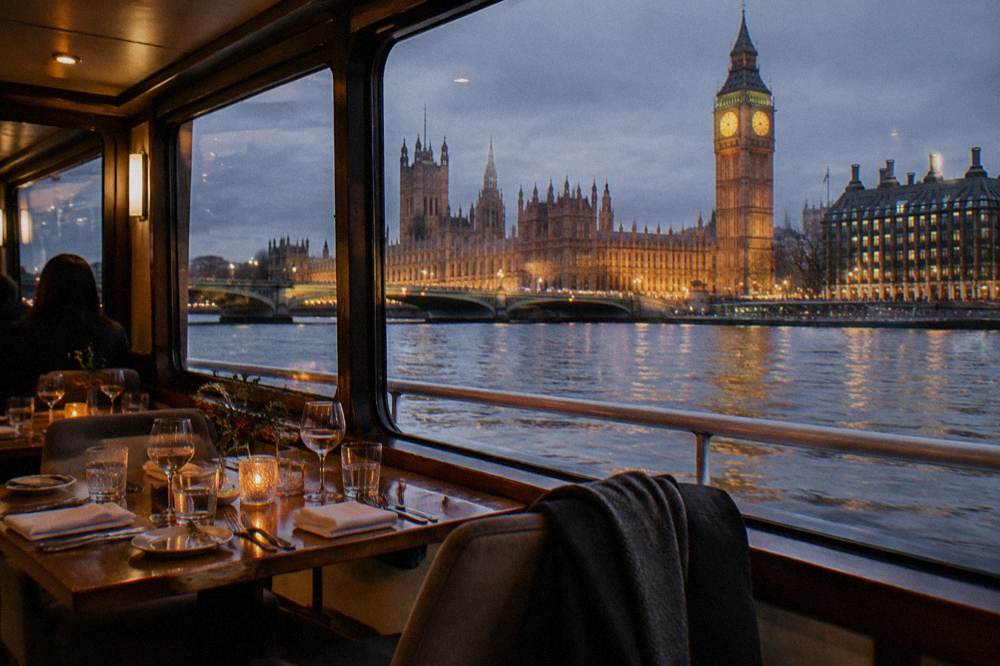
The indoor half of December London is warm enough that a full outdoor outfit is a problem. The roster's seated products make the point well. The "Afternoon Tea Cruise, 1.5 Hours", a year-round river product that runs through the Christmas season, is rated 4.4 from 3,938 reviews and from $53 per person, and the listing notes it is likely to sell out. It is a heated vessel with a full tea service, so the clothing question is not warmth but whether you can sit comfortably in a sweater, and whether your layers fit in the seat with you.
The same applies to the Christmas party sailings. The "Party Lunch Cruise, 3 Hours", from $99 per person with 17 reviews on its listing, and the "Party Dinner Cruise, 4 Hours", from $126 per person with 16 reviews, are dressy-but-practical occasions: smart layers you can dine in, with a proper coat and scarf for the pier walk before and after. The Christmas Day options, the "Christmas Day Lunch, 3.5 Hours" cruise from $232 per person and the "Christmas Day Sightseeing Cruise" from $43, both with stated 25 December sailings, follow the same logic, and the sightseeing version is only 1 hour, so the outdoor exposure is short.
Museums flip the equation in your favour: they are free of weather and heavy on walking, so the indoor outfit is a walking outfit. The Natural History Museum is closed 24 to 26 December, and the major museums follow a similar 24 to 26 December closure pattern, but on any ordinary December day a museum is a warm three-hour stop where your base and mid layers carry you and the coat lives in a locker or on your arm.
The tier B year-round products deserve honest labelling here. The "1960s Routemaster Tea Bus", rated 4.4 from 2,121 reviews and from $94 per person, is a year-round afternoon tea experience that runs through the Christmas season, not a Christmas product, and the Dickens small-group walk at from $120 per person is likewise a year-round tour. Both are indoor or slow-moving, so both reward the same stripped-down indoor kit. The Snowman-themed tea bus, from $47 per person with 14 reviews on its listing, is the genuinely festive version, and it is a heated bus: dress for the photos, not the weather.
What Should You Pack Beyond The Clothes?
Pack a compact umbrella, a power bank, blister plasters, a small daypack for shed layers, a reusable water bottle and a thin pair of liner gloves you can keep in a coat pocket. Hand warmers are optional but earn their space for evening light trails. A cross-body or zip-closing bag beats an open tote on crowded market nights.
The umbrella is the most London-specific item. December rain is frequent but usually light, and a folding umbrella you can deploy in three seconds gets used five times a day where a heavy rain jacket stays on and makes you sweat. Carry both: the umbrella for light rain and the shell's hood for wind and heavier bursts.
The daypack is the layering system's home. Everything in the four-layer plan above only works if the shed layers are on your back rather than left behind. A 20-litre pack swallows a puffer, a scarf and a water bottle without being luggage, and it doubles as the market bag for the evening.
| Item | Why it earns its space | Where you will use it most |
|---|---|---|
| Folding umbrella | Light rain, five times a day | Everywhere; the city's default weather tool |
| Daypack, about 20 litres | Carries shed layers so the system works | Museums, buses, markets |
| Liner gloves | Thin enough for pockets and touchscreens | Queues, decks, trails |
| Blister plasters | New boots fail on day one | Any walking-heavy day |
| Power bank | Cold kills phone batteries fast, and you will navigate by phone | All-day sightseeing |
| Hand warmers | Two hours standing still after dark | Light trails, rink spectator duty |
The power bank deserves a mention beyond the table: cold weather drains batteries noticeably, and a December evening in London involves maps, tickets and photos all running off one phone. A dead phone at 9pm in Kew, where entry is timed and the car park must be pre-booked at GBP 13.50 to GBP 15, is a solvable problem that is better never to have.
The bag-security point is a quiet one. The busy market evenings, especially around the Covent Garden switch-on on 12 November and the Regent Street traffic-free evening on 5 November, are shoulder-to-shoulder crowds. A zip-closing cross-body bag removes the problem entirely.
How Does Christmas Day Itself Change What You Wear?
On 25 December, London has no Tube, no buses and no national rail under the usual pattern, so you will walk or take a taxi, which means comfortable shoes matter more than on any other day. The Royal Parks stay open and free, most attractions close, and the two roster cruises with stated 25 December sailings are the structured options, so the day's outfit is a walking outfit with a warm indoor finish.
The transport fact drives everything. The 2026 festive timetable has not been published yet, so the honest line is last year's pattern: no TfL services on Christmas Day and a reduced Sunday-style service on Boxing Day, so check with Transport for London in December. If your Christmas Day plan involves walking to Westminster Pier for the Christmas Day lunch cruise, 3.5 hours from $232 per person, or the 1-hour sightseeing cruise from $43, your shoes are the plan.
What is open shapes the outfit too. The Royal Parks remain open and free on Christmas Day, which makes a long winter walk the default activity for many visitors, and a park walk at 5 C is a four-layer job with real footwear. Westminster Abbey and St Paul's hold Christmas Day services rather than sightseeing hours, and the Warner Bros. Studio Tour is closed 25 and 26 December, so the studio's snow season, 14 November 2026 to 17 January 2027, is a before-or-after plan, not a Christmas Day one. The studio ticket itself, from $122 per person with branded-bus transport on the "Harry Potter Studio, Branded Bus" product, rated 4.7 from 20,108 reviews, is for the studio visit; the listing does not state that snow-season extras are bundled in.
For the evening, hotel dining and Chinatown restaurants are the open kitchens, and both are warm, so the Christmas Day wardrobe is really two outfits: a layered walking kit for the park and a smart-casual set underneath for dinner. That is the layering thesis of this whole page in miniature, and Christmas Day is simply the day it matters most.
What Is The One-Outfit Answer For A First-Time December Visitor?
If you want a single answer: merino base layer, wool sweater, packable puffer, waterproof hooded shell, waterproof boots with tread, warm hat, gloves, scarf, and a folding umbrella in a small daypack. That outfit handles a morning market, an afternoon museum, an evening open-top bus ride and a late light trail without going back to the hotel. Everything else in this page is refinement around that core.
It works because each piece covers the failure mode of the day. The shell handles rain and the open deck's wind. The puffer handles two hours of standing still after dark. The boots handle mud, wet pavement and the stairs of the Underground. The base and mid layers handle the overheated interiors. Nothing in the set is single-purpose, which is what makes it a system rather than a pile of clothes.
Test it against the roster's range of evenings. On the open-top bus, from $40, you wear everything. On the afternoon tea cruise, from $53, you wear the base and mid and carry the rest. On the markets walk with mulled wine, from $61, you wear all of it and shed the puffer at indoor stops. On the party dinner cruise, from $126, you wear the smart version of the mid layer and check the rest. One outfit, five itineraries.
The final honest note is about expectations. London in December is a mild-winter city with a damp edge, not a snow-globe one. The visitors who struggle are not the ones underdressed for cold, they are the ones whose shoes soaked through at 2pm and whose single heavy coat had them sweating in every shop. Solve dampness and layering and the weather stops being a topic, which is the goal: December in London is for the lights, the markets and the river, and the right clothing is simply what lets you stay out for all of it. The advice on this site, Christmas In London, exists to keep you outside long enough to see it.
For the full evening-by-evening picture, see things to do in London at Christmas and the Christmas lights bus tour guide, and for the colder end of the season's outdoor maths, the Winter Wonderland ticket guide breaks down what a full day there costs.
Common Questions About Dressing For London In December
How To Dress For London In December?
Wear a breathable base layer, a warm mid layer, a packable insulator and a waterproof shell, with waterproof walking shoes, a hat, gloves and a folding umbrella. Typical December days run 8 to 10 C with lows of 3 to 5 C, and the layering system exists for the constant move between cold streets and heated interiors.
Do I Need A Heavy Winter Coat For London?
No. London's December cold is damp and moderate, rarely far below freezing, so a layering system with a waterproof outer layer outperforms a single heavy coat. A thick parka becomes a liability in heated shops, buses and museums, and it is too bulky to carry when you take it off.
Will I Need An Umbrella Every Day?
Probably on most days. December brings roughly 50 to 60 mm of rain across the month, usually in light, persistent bursts rather than downpours. A compact folding umbrella handles most of it, with your shell's hood covering the windier spells.
What Shoes Should I Wear To Winter Wonderland And Christmas At Kew?
Waterproof boots or walking shoes with real tread. Winter Wonderland's ground is grass and gravel that turns muddy in rain, and the Kew trail is roughly 3km, partly unpaved, and walked after dark. Dry feet with grip are the single biggest comfort upgrade of the season.
How Cold Is The Top Deck Of A Christmas Lights Bus Tour?
Cold enough to plan for: you are stationary in moving air after dark, so 8 C on the street feels close to freezing on exposed skin. Take a windproof shell, a warm hat, gloves and a scarf, or ride the heated lower deck instead. The upper deck has the better view, and the right clothing is what lets you keep it.
Does It Snow In London In December?
Rarely. Snowfall happens in London some winters but sustained lying snow in December is uncommon. Plan for rain, damp and early darkness instead; those are the near-certainties, and the layering system above covers them completely.